
Nakbas. Of Views, Few and Far (In)Between
Dyala Hamzah
I have always been intrigued by how an interview—the term we use to designate what goes on between an asker, an askee, and their potential audience—is but rarely a view in between. A prompt’s function is typically to get the askee to a discomfort zone where the asker expects them to spill the beans, pass the litmus test of their expertise, conjure up the past, and/or admit entry into the no-trespass zone of the self. Of course, different professionals go about interviewing differently. But as the interview is tethered to an outcome, it invariably follows a performative path and will be assessed or enjoyed according to its ability to deliver, by both the asker and their public—with the askee often dropped off on the highway of this three-way transaction. A deliverance or an entrapment, the interview form only exceptionally evolves into a poetic reckoning, transforming the interviewer, the interviewee, and their public; then, and maybe only then, is it deserving of the misnomer, interview.
I have experienced the ruthlessness of the interview at both ends. As a historian interviewing Nakba survivors and their descendants, and as a public intellectual being interviewed as one such descendant, I feel I have both subjected others and been subjected myself to a form of assault. By assault, I don’t mean that these interviews lacked in ethical integrity or proper methodology, but rather that there is a violence embedded in our prevailing methods and ethical assumptions. No amount of historical knowledge, open-endedness, empathy, cultural sensitivity or competence, humility or self-effacement, skillful nudging or forbearance can prepare an oral historian to take on trauma. Breaking through the formidable walls erected by memory risks, paradoxically, losing sight of the subject and becoming obsessed—indeed, self-besieged—by the very walls one is attempting to tear down. I have labored against a characterization of the Nakba as “kerfuffle” or “the problems.” I have struggled with the rigid confines of worldviews in which politics and trade are set apart, to explain away how Palestine was lost. At my interviewing worst, I have walked a man back in time to his old Jerusalem private school, even as his jogged memory kept wanting to walk away into the exile years. And he obliged. Gracefully. Dutifully. Leaving me to face the full scale of my intrusions. If talking about it is also resistance, where does that leave the resistance to talking about it? And the resistance to the resistance to talking about it?
More jarring still than the oral historian’s interview is the journalist’s, whose validity is premised on the denial of the interviewee’s right to edit themselves. Something resembling theft is at work when one is told they cannot walk or take back what they said. As Lisa Henderson writes about public photography, the value of recording is treated as so self-evident as to render consent dispensable.{1} In what amounts to a bizarre indictment, a journalist will often slap you with a “you said this.” No, actually I said that! Or rather: this and that, this in conjunction with that! It seems utterly self-defeating when journalists cut midway into an argument, center a benign or marginal statement, turn into a subheading some remotely relevant issue, or leave out entirely a most salient point. How can that gotcha moment vindicate the “truth” in any way? What truth exactly is being manufactured by misquotation? If the “right to misquote” is a right to tamper with the texture of an utterance, i.e., with sequence and context, how can journalism’s interviews ever aspire to be views in between? In-betweenness accrues from a mutual testing of the frame—i.e., from mutually agreed-upon assignations of relevance.{2} It is not an interference with an editorial line or an assault on intellectual integrity. Rather, it is an engagement with the power differential at play, an in-built contestation of the interview as data, a fluid back-and-forth, a social interaction around a voice centered, rather than framed.
The screening program talking about it is also resistance is an invitation to peek through frames—this time, the camera’s—and reflect differently on interviews. The many threads that weave together these tapestries of indigenous restoration derive from handlooms that have been thoroughly disjointed—frames unframed in the process of representing the unrepresentable: the annihilation of entire human worlds.
Qais Al-Zubaidi’s Far from the Homeland (1969), recorded in the Palestinian refugee camp of Sbeineh, south of Damascus, depicts a world devoid of adults. The camp’s existence is signified by the giggly voices of children, its adults conjured only through mischievous chatter or the calling of their names, their spectral existence having the quality of an evocation, itself revisited by the children’s filmed reactions to Al-Zubaidi’s footage. When Al-Zubaidi seats children in front of the camera in a more formal interview to ask them about the future, they freeze. “I want a pen,” says one; “I want to be a teacher,” says another—as if to dodge, momentarily at least, the staggering weight of their political futures. Recording the compounded loss, ethnic cleansing, defeat, and humiliations of 1948 and 1967 in such an oblique way (the Sbeineh camp population fled northern Palestine and then the Golan), Far from the Homeland exposes what Nadera Shalhoub-Kevorkian calls Israel’s unchilding of Palestine’s children—the lifetime wreckage of stolen childhood, of children ejected from childhood.{3}
FAR FROM THE HOMELAND (Qais Al-Zubaidi, 1969).
The picturing of absence is made even more palpable in Jayce Salloum’s untitled part 3b: (as if) beauty never ends (2000–2002). Blurred images of Sabra’s and Shatila’s corpses (sometimes even impressionistic stills of the strewn shoes of the slaughtered) are collaged with the voice of Abdel Majid Fadl Ali Hassan, who recounts the story told by the rubble of his home in Kweikat, in the north of Palestine, as he returns to find the village desolate, depopulated, and destroyed. Where have you gone? asks the bodiless house. And the lifeless bodies answer as much as Abdel Majid’s bodiless voice: We have been exterminated; we have become a hovering, melancholy presence in absence.{4} The piece maps 1982 onto 1948, flattening time and marking the obscene temporality of occupation.
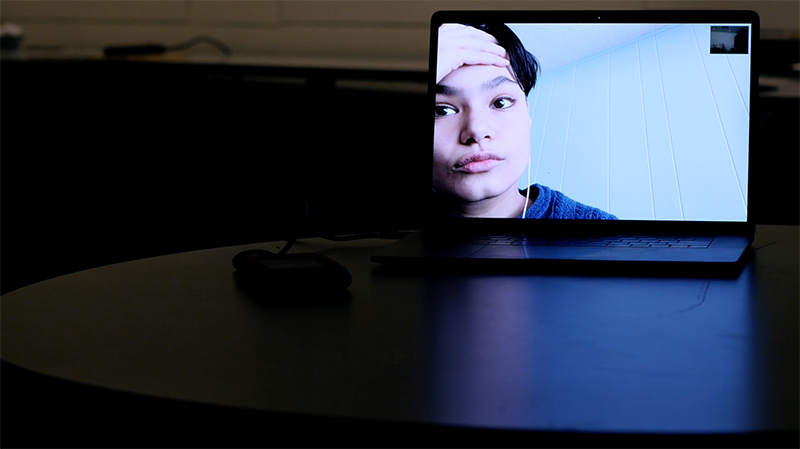
Salloum’s untitled part 1: everything and nothing (1999–2001) offers another subversion of the conventional interview. Filming Soha Bechara in her tiny student accommodation, the forty-minute zooming in and out on her face leaves her dictating the rhythm and the direction of the interview, centering her silent listening. Reproducing the suffocating confines of her prison cell, Salloum’s narrowly framed interview of Bechara achieves an impossible grace, nurturing the dignity of a woman subjected to a ten-year ignominy at the Khiam detention center, run by the South Lebanon Army on behalf of Israel, by recording a voice he could not understand.{5} While untitled 3b speaks to the flattening of time, untitled 1 speaks to the abrogation of distance—that which brings Khiam and Beirut into a Paris student dorm, and that which brings incommensurable worlds together and bridges linguistic divides through trust.
For its part, Sky Hopinka’s Dislocation Blues (2017), a telling of Indigenous resistance at Standing Rock and the formidable solidarity movement it gathered, is sharply driven by hypermediation and deferent distancing. While voices are disembodied, bodies are shown from afar, from behind or through a double screen. Cleo Keahna’s body comes to life, identity, and belonging through a sense of collective purpose, a sense that, however, dissipates once the collective does. Refraining from penetrating the collective and exposing its members, or isolating their voices, Hopinka signals a powerful truth, one that strikes at the heart of the colonial-liberal ordering, and at its academic pillars: that the story can be told only by the collective; that there is no getting at the story (and by extension, at history) other than through the collective authorial voice. If Cleo speaks through a (decentered) screen within a screen, and others through their movement within crowds, filmed from outside or at leg level, it is to subvert the fixation and concentration of authority. And this is not only to appease the all-too-justified concerns about crowd infiltration, but to foreground Indigenous resignification.
 DISLOCATION BLUES (Sky Hopinka, 2017).
Refracting life as collective resistance, the art of the interview is repurposed by Al-Zubaidi, Salloum, and Hopinka to challenge the expectation of finding singular meanings, purpose, or solace in atomized self-containment. As if echoing the mother of all (counter)interviews in Ghassan Kanafani’s Returning to Haifa (1969), a novella about identity as a function neither of biology nor of nationality but of moral/political commitments to a cause, each of the four short films adheres, in its own way, to Kanafani’s “man is a (collective) cause,” prevailing even over mass death, dislocation, dispossession, even over justice deferred and denied—as if beauty never ends.
Title video: Far from the Homeland (Qais Al-Zubaidi, 1969)
{1} Lisa Henderson, “Access and Consent in Public Photography,” in Image Ethics: The Moral Rights of Subjects in Photographs, Film, and Television, ed. Larry Gross, John Stuart Katz, and Jay Ruby (Oxford University Press, 1991), 92.
{2} My understanding of the frame relies on Goffmanian sociology, at least insofar as it allows me to point out journalism’s indifference to context and the epistemic bracketing of what is socially (and historically) ir/relevant. Erving Goffman, Frame Analysis: An Essay on the Organization of Experience (Harvard University Press, 1974).
{3} Nadera Shalhoub-Kevorkian, Incarcerated Childhood and the Politics of Unchilding (Cambridge University Press, 2019).
{4} “Present absentees” (or IDPs: internally displaced persons) are the ethnically cleansed Palestinians who remained or came back to the areas of their homes during the Nakba of 1947–49.
{5} “It wasn’t until six months to a year later, when Soha’s text was translated, that I could read what had transpired. I knew that in those short hours a trust had developed, enabling her to accept my mediation. The material that I recorded of the time spent with her is not precious; it’s just time, a conversation, and intense intimacy at a close and unbreachable distance.” Jayce Salloum, “sans titre/untitled: Video Installation as an Active Archive,” in Projecting Migration: Transcultural Documentary Practice, ed. Alan Grossman and Áine O’Brien (Wallflower, 2007), 169.
