
Cell Formation, Disinformation
Rose Rowson
On September 22, 2023, thirty-four-year-old Brittany Watts had a miscarriage in Warren, Ohio. Her waters had broken a few days earlier; doctors advised her that her pregnancy was unviable and that she was at risk of dying; they recommended that Watts be induced. Left to wait by doctors while the hospital risk-assessment team debated the legality of inducing an unviable fetus at twenty-one weeks and five days—the legal cutoff for abortion being twenty-two weeks in Ohio—Watts took herself home to wait there instead. It was at home that her miscarriage took place, while she was sitting on the toilet in her bathroom. Following her miscarriage, Watts returned to her local hospital in Warren; police were tipped off by an attending nurse that Watts had arrived without the fetus. Raiding her home, police originally believed that the fetus was in a bucket in the back garden, to be found among the uterine lining and large amounts of blood that Watts had expelled into and decanted from the toilet bowl. Not finding it there, investigators instead discovered the fetus stuck in the trap of the toilet. One officer at the scene reached into and around the bend of the toilet, and “felt what appeared to be a small foot with toes.”{1} The toilet was broken open to retrieve the fetus, and Watts was arrested and charged with felony abuse of a corpse.
During the trial, Watts’s lawyer, Traci Timko, challenged the prosecution on the definition of the term corpse to describe a product of human conception that was never viable, and requested guidance for the appropriate disposal of early-term spontaneous abortions, many of which happen without women realizing. Watts’s defense also followed on the work of such scholars as Dorothy E. Roberts by arguing that, in its imbrication of the prison and social welfare apparatuses, the case against Watts continued an American tradition of extreme punitive measures against black mothers.{2} Under Ohio law, felony abuse of a corpse is defined as treating a corpse “in a way that the person knows would outrage reasonable family sensibilities” or “that would outrage reasonable community sensibilities.” In 1984, this law was challenged for being unconstitutionally vague, but was upheld on the basis of “the words ‘treat,’ ‘human corpse,’ ‘way,’ ‘outrages,’ and ‘sensibilities’ [being] commonly understood by persons of common intelligence.”{3} Watts’s race, the dual status of uterine matter as bodily waste and life support, and the administrative dawdling precipitated by Dobbs are a challenge to the “commonsense” basis of this law.{4} Watts was acquitted by a grand jury in early January 2024. Making his closing statement on the trial, presiding Judge Terry Ivanchak commented that “there are better scholars than I am to determine the exact legal status of this fetus, corpse, body, birthing tissue, whatever it is.”{5}
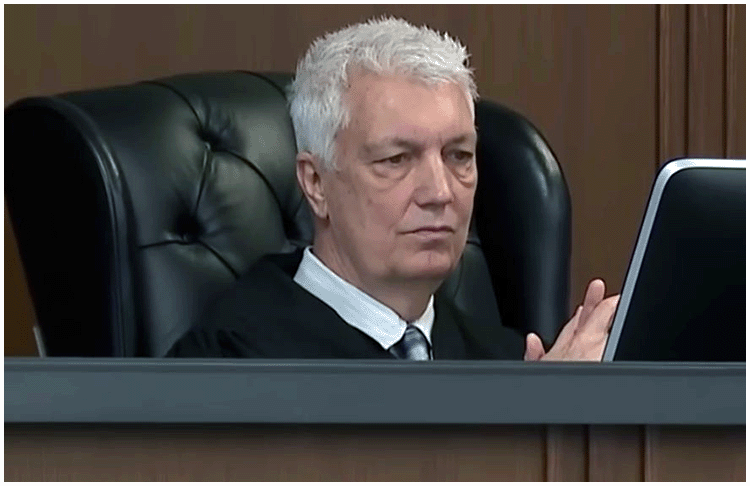 Judge Terry Ivanchak presides over the trial of Brittany Watts.
Better scholars than Judge Ivanchak have long identified the problem of “whatever it is” as central to the critical study of reproductive rights. As Barbara Johnson asks, “What is the debate over abortion about, indeed, if not the question of when, precisely, a being assumes a human form?”{6} Meredith W. Michaels is thinking along similar lines when she proposes that “the term ‘fetus’ is radically ambiguous and has come to signify, outside of embryology, whatever is ‘in there’ from the proverbial moment of conception onward.”{7} Putting it slightly differently, Johnson continues, “Can the very essence of a political issue—an issue like, say, abortion—hinge on the structure of a figure?”{8} Michaels would answer in the affirmative, that in the struggle for reproductive rights “the feminist fetus was nothing more than a blob of protoplasm.”{9} In creating this “blob,” the project of protecting reproductive rights sought to decouple the argument for safe healthcare access from the representational schema that insists that all fetuses, regardless of their capacity to survive independently outside of the womb, share a concretely human form from their point of conception.
Brittany Watts’s case invokes the question of human form that has mediated the abortion debate in America from its federal legalization in 1973 through to and beyond the 2022 overruling of Roe v. Wade. From single body parts to imagined populations of the unborn, arguments against safe abortion access operate between scales and across milieus. In this essay, I consider how antiabortionists insist on fetal human form through techniques of personifying evidence, and I further propose a rhetorical continuity between evidence speaking for itself within the forensic paradigm and the pro-life imperative to speak for the voiceless unborn. I query whether there is an escape route for pro-choice feminists, whether there can be debate over access to reproductive healthcare that is not governed by these babylike forms. I believe feminist critics pay disproportionate attention to certain antiabortionist texts. Yet I have also found that attempts to produce pro-choice media offerings that circumvent the rhetorical strategies espoused by these texts tend to breezily repeat these same strategies. My texts of choice here—shock-abortion-doc classic The Silent Scream (1984), pro-life tearjerker Unplanned (2019), images produced in 2022 by patient-advocacy-cum-disinformation-battlers MYAbortion Network, and reproductive-rights slice-of life film Zurawski v Texas (2024)—are broadly exemplary of these tendencies. By comparing these texts, I do not wish to adjudicate or decide on the final, right way to represent fetal remains or the unborn, but rather to question whether representing experiences like abortion and miscarriage should remain the horizon for reproductive justice.
A responding officer blindly reached into Brittany Watts’s bloody toilet bowl and “felt what appeared to be a small foot with toes.” Human form and identification of a corpse, in this case, can apparently be felt in the structure of a foot. This is one foot among many. In her book Tiny You: A Western History of the Anti-Abortion Movement, historian Jennifer L. Holland discusses how, from the 1970s onward, Precious Feet pins, gold brooches modeled after photographs of a ten-week-old fetus and worn by so-called pro-lifers, “condensed a number of central anti-abortion arguments—about fetal life, about rights, and about genocide.”{10} Precious Feet pins are marketed as an item that “breaks the ice and helps you speak for those who cannot speak for themselves.”{11} They are also intended as a reminder, per Precious Feet creator Virginia Evers, that all humans are created in the image of God, that “He declared us His very own children from the moment of fertilization.”{12} The foot felt around the bend of the toilet and the golden feet adorning pro-lifer lapels are synecdochic: A body part stands in not only for the singular fetus, but for a whole population of the unborn who must have their subject status defended, who must be spoken for, and who were created in the image of the Almighty.
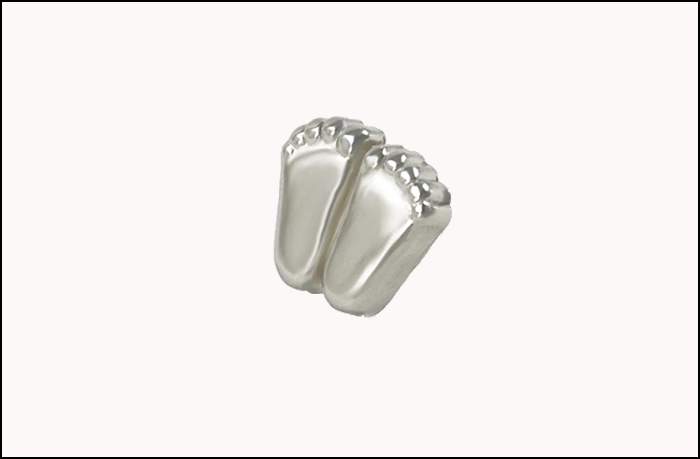 An electroplated silver-gilt-finish replica of what is intended to represent the size of the feet of a ten-week-old fetus.
Johnson understands the rhetoric around abortion as functioning much like the poetic technique apostrophe, which she glosses as the “address of an absent, dead, or inanimate being by a first-person speaker. . . . Apostrophe is a form of ventriloquism through which the speaker throws voice, life, and human form into the addressee, turning its silence into mute responsiveness.”{13} Within the forensic paradigm, human remains also do a kind of speaking. Thomas Keenan balks at the claim by field-building forensic anthropologist Clyde Snow that the key to the “objective” study of evidence is “to let the bones speak for themselves”: “Of course they can’t,” Keenan clarifies. “But they have started appearing in international courts, war-crimes trials, human rights investigations, and other public forums where they do something akin to testifying: things are speaking, without saying a word.”{14} Keenan and his sometime coauthor Eyal Weizman use the term prosopopoeia to describe this animation of remains within trial settings, where there is “the attribution of a face or a voice to something inanimate.”{15} While apostrophe is a mode of address, a speaking to, prosopopoeia imbues an inanimate object or a dead person with the capacity to speak for itself; both are rhetorical processes of personification. If apostrophe speaks to a dead someone or an inanimate something and accepts its muteness as response, prosopopoeia “posits the possibility of [that-which-is-spoken-to’s] reply and confers upon it the power of speech.”{16}
Paul de Man calls prosopopoeia “the trope of autobiography, by which one’s name . . . is made as intelligible and memorable as a face. Our topic deals with the giving and taking away of faces, with face and deface, figure, figuration and disfiguration.”{17} De Man’s description aligns with the project of forensics, which at its broadest figures out and gives figure to past events, making them intelligible as evidence. Human remains used as evidence can “speak” only via mediation, wherein the act of speaking isn’t actually speaking as such but instead ensures that indexical traces come to signify something. In the courtroom, these traces must “do something akin to testifying”: The bones of los desaparecidos or the skull of Josef Mengele, to take Keenan and Weizman’s examples, can take the stand and have something to “say” about the past. Based on the testimony of these traces, something can be done about the future. That something may be the arrest of a perpetrator, the creation of a new law, the repatriation of remains or artifacts.
Keenan writes that “human remains are always subject to a politics of comparison or analogy: bones are buried as something, as a hero, as a soldier or a guerrilla, as a member of a community or a faith or a political party.”{18} Those who speak for the unborn, by contrast, throw their voices into an impossible future and an unconfirmable past. That is, indeed, the imperative of their apostrophe: to advocate not for an actual individual or discrete group of people, but for a potential population with imagined capacities that are determined by whomsoever is throwing their voice. Priscilla Huang proposes that when former Republican House majority leader Tom DeLay and his colleagues mourned for those aborted since Roe v. Wade passed in 1973, there was an “implicit understanding” that these unborn millions “would have been white, and, at the very least, non-immigrant.”{19} Huang’s observation here condenses the antiabortion apostrophizing project, where the muteness of a white, nonimmigrant unborn population is drowned out by the unfavorable alternative that replaced them. This comparative technique appears elsewhere in antiabortionist media. In evangelist Ray Comfort’s film 180 (2011), for example, he challenges his man-on-the-street interviewees to explain the difference between the millions killed in the Holocaust and the millions of terminated pregnancies since 1973, directly comparing the description of early-term fetuses as nonhuman to the Nazi dehumanization of Jews. Squinting against the glare of the sun on Venice Beach, Comfort’s pro-choice interviewees hasten to disassociate themselves with the genocidal project of the Third Reich. Maybe when you put it like that, they say; maybe you have a point.
Sociologist Lilie Chouliaraki describes this pro-life playbook as “pitching the actual pain of people . . . against the imagined pain of an unborn embryo.”{20} This politics of victimhood, as she calls it, does not depend on actual suffering but deploys victimhood as “a contingent and malleable speech-act, a linguistic claim to suffering that bears no necessary relationship to the structural vulnerabilities the claimant may be experiencing.”{21} Chouliaraki’s example of this vis-à-vis abortion is the transfer of victimhood from those who became pregnant via sexual assault to the unborn children whom those people may abort. By figuring the unborn as perennial victims with a right to life that is under constant threat, antiabortionists flatten out the various reasons why a pregnancy might be terminated. These reasons—medical, financial, social—are viewed instead as enacting violence through the selfish refusal to take responsibility for another life. Chouliaraki clarifies the stakes of apostrophe and prosopopoeia as rhetorical methods that imagine subjecthood at the expense of those experiencing pregnancy complications in their myriad forms. In imagining “mute responsiveness” or the capacity of the dead or inanimate to reply, pro-life rhetoricians disallow all other forms of response.
As Meredith W. Michaels and Lynn M. Morgan put it, “To talk about fetuses has been thought to cede to the pro-life movement its major premise, and so to foreclose the feminist insistence on reproductive freedom for women.”{22} If the antiabortion movement is responsible for producing the cultural forms that mediate debates around fetal rights and subjecthood, and hold control over the rhetorical ground upon which such debates can be undertaken, then feminist critics are in a bind. When challenging the political formations around the representation of the unborn, it’s always a trap to allow those who oppose abortion to set the terms of debate. Feminist critiques of the antiabortion movement suffer when they privilege certain media whose aim is to personify, such as Lennart Nilsson’s photographs first published in Time magazine in 1965, and the notorious 1984 short film The Silent Scream. Repeated return to these examples enacts an academic canonization and performs a legitimizing operation that is the obverse of pro-life advocation of fetal subjecthood.
In The Silent Scream, abortionist turned pro-life activist Dr. Bernard Nathanson narrates a recorded real-time ultrasound of a termination procedure. The twelve-week-old fetus writhes and kicks as a suction apparatus enters the uterus of an unnamed woman, breaking off the fetus’s limbs and vacuuming them up; pointing to the head of the fetus, Nathanson claims that its mouth is open in an expression of pain, the eponymous silent scream. He must speak this unheard scream into existence.
It seems easy enough to debunk Nathanson’s claims, as has been done extensively in the four decades since the film’s release: At twelve weeks, fetuses cannot feel pain; they move only by reflex; they cannot make any noise; the ultrasound video is enlarged; the video is sped up; and so on. Writing on the film in 1987, Rosalind Petchesky cautions, however, that “this literal kind of rebuttal is not very useful in helping us to understand the ideological power the film has despite its visual distortions and verbal fraud.”{23}
Petchesky’s warning about the limited power of rebuttal is vindicated when watching the 2019 film Unplanned, an adaptation of Planned Parenthood employee turned pro-life activist Abby Johnson’s memoir of the same name. Working as a Planned Parenthood clinic director in Texas—that is, administrative staff, not medical staff—Johnson narrates how she was beckoned into an operating theater to act as an ultrasound technician during an abortion. With no apparent prior training, she holds an ultrasonic probe in place against an unnamed woman’s abdomen, and an image of a fetus is shown on a screen. The presiding surgeon begins the procedure, glibly dismissing the whimpers of his patient and snarking “Beam me up, Scotty” as an aside to his nurse as he powers up a vacuum aspirator. The fetus appears to writhe and kick, moving away from the catheter before being sucked up by it. The film cuts back and forth between Johnson and the procedure, both on the ultrasound screen and the surrounding medical apparatus; as the procedure ends, Johnson gazes at an amorphous, empty sonogrammed space where the now aborted fetus once was. Fetal—that is, human—form has been destroyed by formlessness, and Johnson leaves the room in tears.
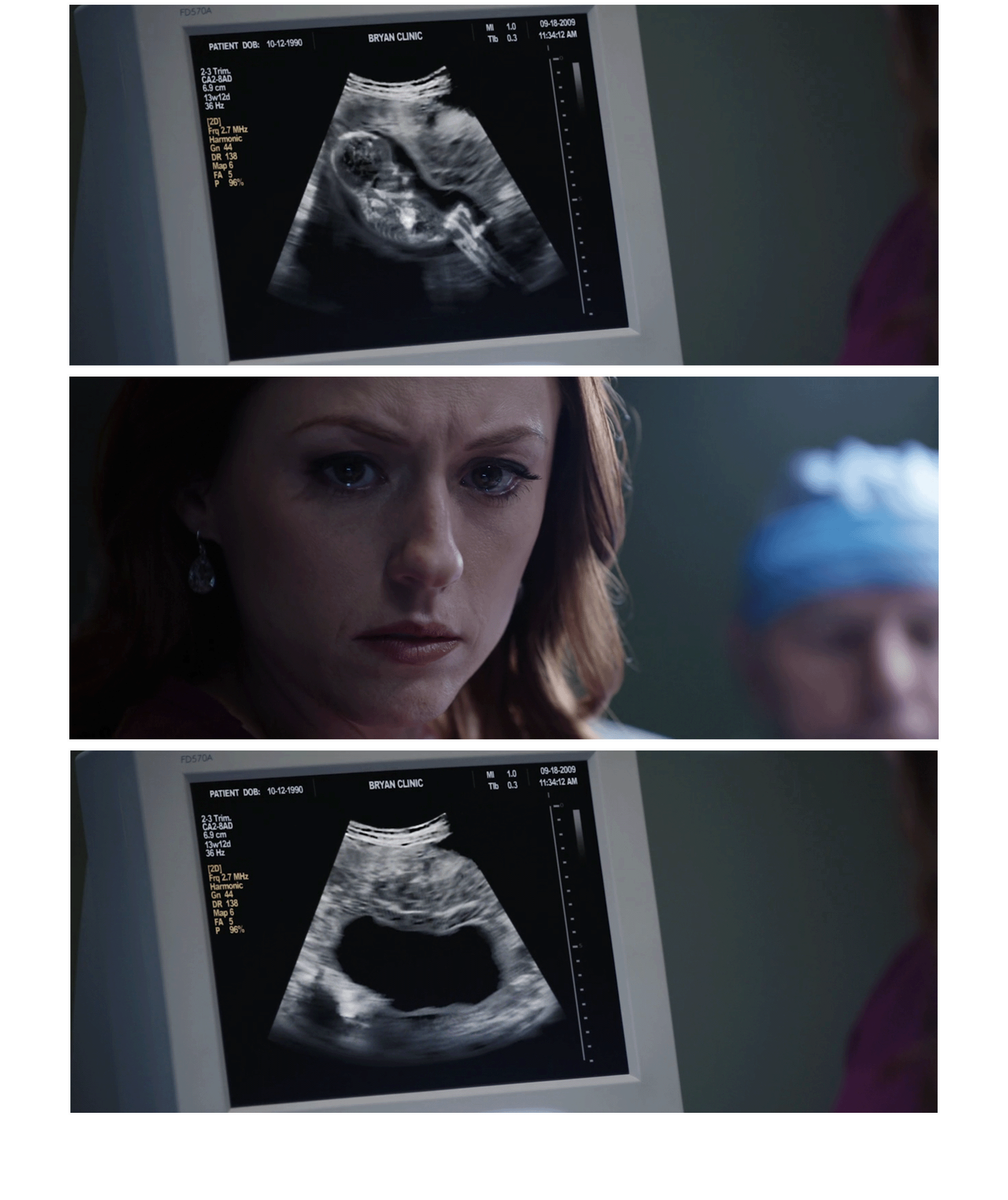
This opening scene in Unplanned uses the rhetoric of autobiography to repeat the claims made in The Silent Scream. Gone are Bernard Nathanson’s to-camera assurances of his medical expertise and presentations of evidence, replaced by a fictionalized Abby Johnson’s assertions that she was there, and this is what she saw. Diana Fuss writes that “when prosopopoeia is allowed to speak freely, it speaks loudly, claiming to be the figure for figurality itself, the very voice of poetry.”{24} To paraphrase Fuss, it seems here that Abby Johnson’s prosopopoeia is the very voice of evidence. Unplanned is structured through nesting recollections: The first time we are shown the abortion sequence, Johnson’s narration doubles back, telling the audience how she ended up working for Planned Parenthood in the first place. By the time Unplanned makes its way back to the abortion scene, we also know that Johnson had two abortions of her own, and that she rose through the Planned Parenthood ranks while becoming increasingly alarmed and disillusioned by their care practices and business model. Unplanned effectively integrates a screening of The Silent Scream into its runtime, while giving face and figure to a young woman who was led astray and snapped back on track. If, following de Man, prosopopoeia is the “trope of autobiography,” as well as, per Keenan and Weizman, a way to understand how human remains affirm their status as evidence, then Unplanned moves between these registers, using its form as memoir to model how one is meant to respond to evidence. Like The Silent Scream, the medical accuracy of the abortion footage in Unplanned was disputed. So was Abby Johnson’s account of her career in reproductive healthcare: As her post–Planned Parenthood career began, reports emerged that she hadn’t quit after a moral awakening, but preemptively resigned in fear that she was on the verge of being fired.{25} But what use is it to offer a response to Unplanned, to oppose its figuration of reproductive health access, to rally against Johnson’s recollection, when rebuttal is the very terrain upon which the film stages its argument? What is the use of providing a fact-based rebuttal to new pro-life cultural forms as they play out the same undebunkable beats?
Or, take the October 19, 2022, article in The Guardian which published a photo series of petri dishes, each holding cellular blobs of varied size and consistency. Presented under the headline “What a Pregnancy Actually Looks Like Before 10 Weeks—In Pictures,” taken by doctors at MYAbortion Network and shared with the intention of easing stigma around abortion and reclaiming fetal imagery from antiabortionists, the images are all of early pregnancy tissue—between four and nine weeks—including embryo, decidua, and gestational sac. Unlike the babylike forms that have come to be associated with abortion—Precious Feet pins, ultrasound imaging—these images show something amorphous, white, and translucent: Any blood has been rinsed away to give a clearer view of the pregnancy tissue. These gossamer remnants present a direct challenge in their illegibility; MYA Network was subsequently accused of providing disinformation. With both cutesy and gruesome presentation of fetal remains a mainstay of American visual culture in the late twentieth and early twenty-first centuries, it is unsurprising that many felt cautious about these newly produced images. MYA Network appears to be broadly aligned with recent challenges to political and cultural norms; these challenges have been couched in distrust of experts and institutions, and also encourage laypeople to trust their own experiences, to do their own research. It seems, however, that questioning the composition of the fetal form may be a limit point for such antiestablishment provocations to received knowledge.
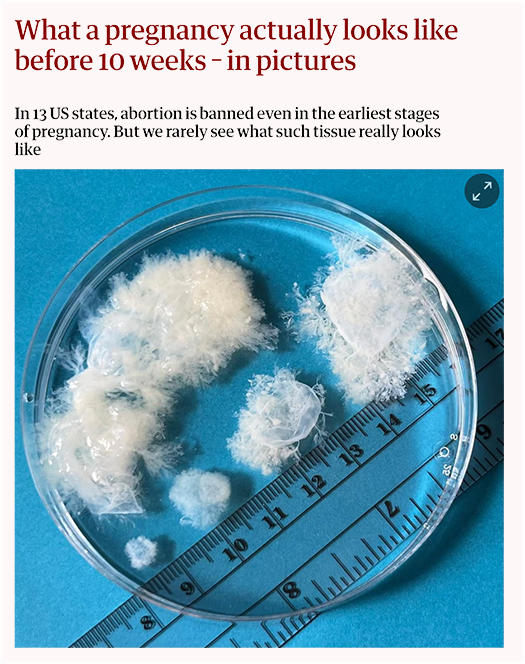 “What a Pregnancy Actually Looks Like Before 10 Weeks—In Pictures,” GUARDIAN, October 19, 2022.
In the photo series, clear dishes sit on an eggshell-blue background. Each is bisected by a clear plastic ruler with centimeter and inch markings, which indicate that the containers are 10 cm across at their widest point; there is no information on their depth. The remains of various sizes cut a placid profile as they float in the dishes, their blue background reminiscent of hospital scrubs, blue industrial tissue paper rolls, Tiffany boxes, or the euphemistic blue liquid used to demonstrate the absorbency of diapers, panty liners, and tampons. As a new entry into the canon of abortion imagery, the MYA Network images are uniquely perplexing in their indeterminacy. In a follow-up article in The New York Times in January 2023, MYA Network doctors Erika Bliss, Joan Fleishman, and Michele Gomez addressed the reception of the images. They said that even though the photographs “weren’t consistent with those often seen in embryological textbooks, magnified on ultrasounds or used in anti-abortion propaganda,” they were consistent with what doctors saw when doing early abortion procedures, and the images had been verified by a gynecologic pathologist.{26} Citing patient care as its first motive for publishing the photo series, with fighting disinformation coming in a close second, MYA Network launched itself into a fraught and long-fought battle: between the fetus as a medical subject and the fetus as a cultural icon.
MYA’s argument that a fetus is a conglomeration of cells and not a child is consistent with what Michaels identifies as the “blob” method of feminist critique, and is at its core formal: This is what early pregnancy and abortion actually look like. But what use is a claim to the image of truth when, following Petchesky, antiabortion ideology is apparently immune to accusations of fraud and distortion? MYA’s petri dish cells look like nothing at all. That is, of course, part of the point: to assuage the guilt or pain of those either choosing to have an abortion or who have had a miscarriage. They are an outright rejection of the fetus as a cultural icon; shown in neither a serene ultrasound scan nor a macabre display, it simply isn’t there. Pitched in the middle ground between patient care and the fight against disinformation, it would seem that MYA’s dual aims cannot be resolved. If, as Barbara Johnson argues, the argument over abortion hinges upon when precisely a being assumes a human form, and, as I have argued, the understanding of those forms is constructed in part through apostrophe’s speaking to these forms as well as prosopopoeia’s speaking for them, MYA Network is doing a similar thing to antiabortionists in its imperative to speak for those who cannot. Who it speaks for, instead of a population of the unborn, are patients who have had abortions, miscarriages; in its caregiving capacity, MYA Network is also speaking directly to these women.
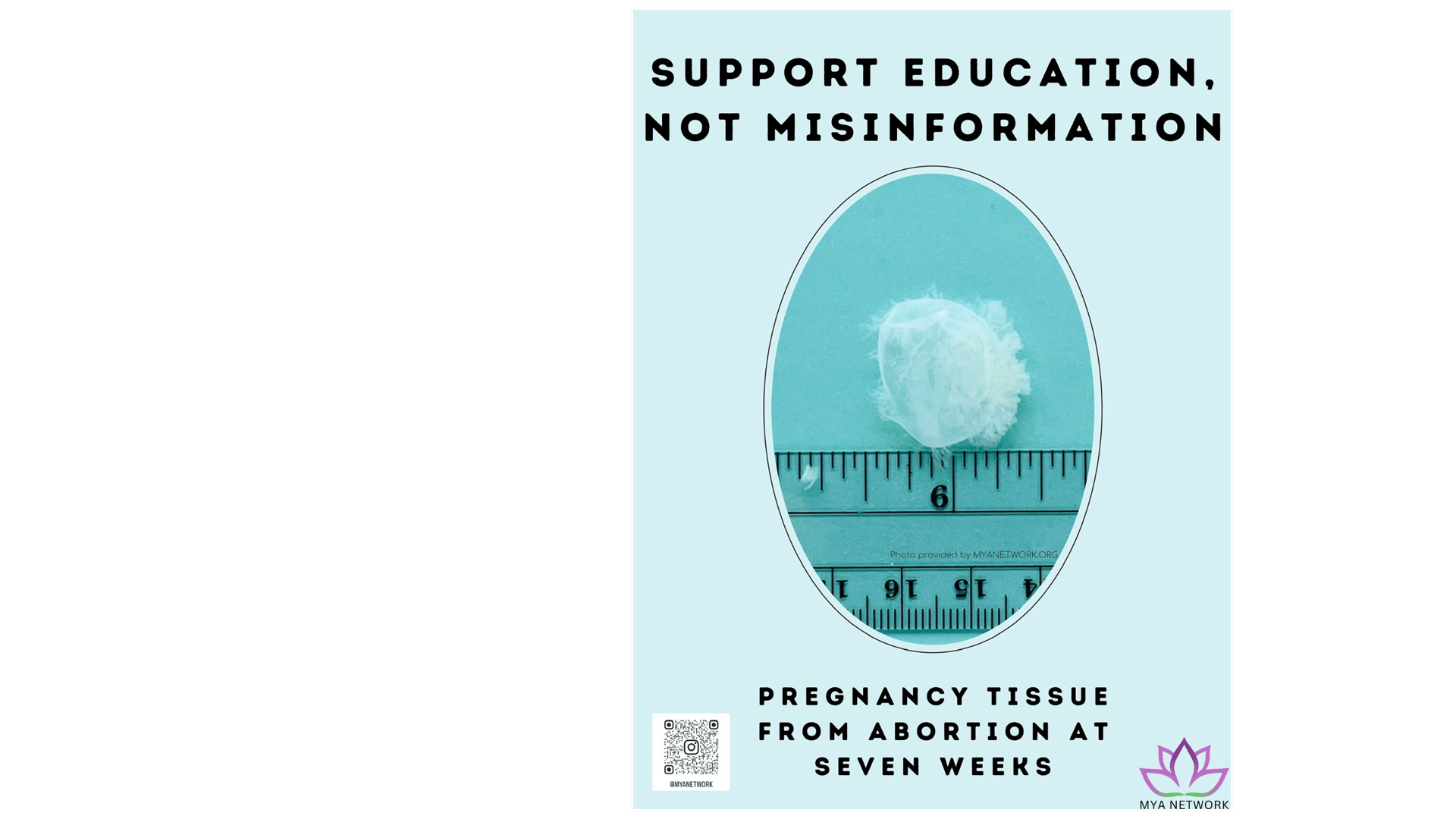
Like pro-choice speaking to and for, MYA’s coolly clinical presentation of the material from early pregnancy erases the gestating body and, indeed, the lives of those women it endeavors to address. The diagrammatics of this series may be wholly appropriate in a clinical setting, providing care to a patient who has miscarried or who has scheduled an abortion. But what of MYA’s second register, its fight against disinformation? Without blood, might this clarity seem like an unnatural segmentation, a revelatory concealment, a denial of the body from which these cells were aborted? Working to collapse and displace the fetal form as the central node of abortion discourse, the MYA images cleave the fetus and its surrounding environment from the gestating body. If antiabortionists separate the fetus from its environment in the womb and figure maternal space as a threat, MYA Network falls into what Emily Martin describes as “a chaotic disintegration of form.”{27} Further, the mode of distribution of these images—first in The Guardian, then onto TikTok, Facebook, The New York Times, the platform that was at the time called Twitter—constitutes a decontextualization that disintegrates not only form but also context, where these images come to represent both the truth of abortion in their indeterminacy and the lies of the pro-choice movement about fetal subjecthood in their refusal to show the world the babylike forms of abortion. Here, where op-eds respond to op-eds, tweets respond to op-eds, tweets are retweeted, retweets become TikToks upon TikToks, there is a networked explosion of cell formation and disinformation.
With Roe v. Wade freshly overturned, MYA Network entered a skirmish in the long war over prenatal visualization, and made a striking challenge to forms of visual disinformation baked into obstetrics. With the organization’s legal access no longer federally mandated, MYA Network doctors made moves to reframe abortion as a medical procedure rather than a moral quandary. Yet to show the globular truth of the abortion process is not to be immune to the pitfalls MYA Network identifies in other methods of obstetric visualization: of enlargement, of omission. MYA thus finds itself in an unwinnable position. While attempting to provide answers—what does an abortion really look like?—this episode instead exposes a flaw in the oppositional logics of the fight against antiabortionists. If information cannot “beat” disinformation—one always runs the risk that information will become disinformation—then what to do instead?
Confronted with the “blob” of the MYA Network images, online commentators are compelled to speak for those remains, ironically reaffirming the pro-life necessity to speak for those with no voice, while addressing and giving form to an unknown, distributed online audience. On any given TikTok, comments abound in both support and dispute of the evidential claims these images make. Yes, some women say, I had a miscarriage, and it looked just like nothing; others say no, my miscarriage bore a tiny human form. Given this online audience’s capacity to speak back to this compulsion to speak for, I am left wondering after the status of personal life experience or autobiography qua (dis)information or evidence. A great deal of the pro-choice movement’s energy, both in the academy and in social movements, has been devoted to debunking the truth value of the images distributed by the antiabortion movement. Squabbling in the comments about the form of an early-term fetus strikes at an issue dear to both sides of the abortion debate: that remembrance of one’s own life experiences can be a challenge to the evidence espoused by those for or against abortion. A staunch pro-lifer miscarries and expels indeterminate fragments ten weeks into a pregnancy, and suddenly sees only cells; an equally staunch pro-choicer experiences the same, and the remains of the pregnancy appear in the form of a foot.
There remains, then, some tension in MYA Network’s aims when it professes a desire to fight disinformation. Writing on the dilemma of women’s experiences, Shelley Budgeon confronts the ironic (mis)alignment between feminist knowledge production and the populist post-truth movement. Budgeon lays out the rift within feminist epistemology concerning experience between second-wave assertions that women are privy to emotive, corporeal, instinctual ways of knowing that are superior to “masculine” rationality, and the understanding that all knowledge is culturally contingent.{28} She argues that the populist post-truth acceptance that all knowledge is situated—a viewpoint ironically aligned with, while not explicitly borrowed from, feminist thought—ensures that female perspectives, most particularly concerning sexual harassment and gender norms, can be easily dismissed as biased. She proposes elsewhere that “while post-truth culture is riven by deeply felt disagreement about what can be said, what can be known, and the relative status of competing claims, feminist epistemology must continue to put forward a defense of women’s personal experiences, upon which feminist political action is based.”{29} I asked above whether challenges to fetal representation constitute a limit point for the distrust of establishment knowledge. If, in advocating for themselves against different kinds of gendered violence, women can have their experiences voided based on apparent bias, then I wonder whether women are also seen as incapable of recognizing the human form of, and appropriately advocating for, the fetuses they are charged with gestating.
Trailer for ZURAWSKI V TEXAS (Maisie Crow and Abbie Perrault, 2024).
What good, then, is experience as a lynchpin of feminist thought? And what, indeed, counts as experience? Maisie Crow and Abbie Perrault’s 2024 documentary Zurawski v Texas leans on experience in its presentation of contemporary reproductive health crises, moving away from visualization of abortion completely in favor of showing the lives of women affected by abortion bans. Crow and Perrault follow Center for Reproductive Rights attorney Molly Duane as she assists a growing cohort of Texan women who faced life-threatening pregnancy complications and were denied abortions. In the first instance, the film draws attention to the unworkability of Texas’s medical exception laws, which decree that women should be allowed abortions as an emergency measure if their lives are in immediate danger. Like Watts’s case, the problem here is one of definition: What counts as life-threatening, and who has the power to decide? Crow and Perrault put little emphasis on visual evidence, instead featuring these women recounting their experiences to camera and on the stand. One plaintiff, Samantha Casiano, begins vomiting in court as she recalls being told that her unborn daughter was developing without a brain and was incompatible with life, but that she would have to carry her high-risk pregnancy to term.
Zurawski v Texas shows this battle for reproductive justice playing out on commutes, during which Duane stares into the middle distance and mouths out opening statements while steadying herself with a subway handrail; on Zoom calls, where Duane toggles between commiserating with clients, cursing in frustrated solidarity with coworkers, attending hearings, being interviewed on news programs; and in everyday drudgery. Life goes on for all involved, whether that be in purchasing headstones, continuing attempts to reproduce, or looking after children born either before or after unviable and potentially deadly pregnancies. Experience, whether put forth as legal testimony, reported to journalists, or spoken to the documentarians, is Zurawski v Texas’s bread and butter. As the film progresses, more and more women join the plaintiffs, emboldened to tell their own stories of doomed pregnancies and insufficient medical care.
 ZURAWSKI V TEXAS (Maisie Crow and Abbie Perault, 2024).
Zurawski v Texas is notable for its commitment to not simply covering these women’s stories, as heart-wrenching as they may be, but presenting reproductive justice as an ongoing struggle that stretches beyond the experiences of one person. I read this film, both textually and paratextually, as expressing the broader social contradictions that maintain women’s reproductive health as a political hot topic. At the time of writing, Crow and Perrault’s documentary does not have a US distributor; the film is available to rent exclusively on independent film platform Jolt for a suggested donation of fifteen dollars. By contrast, Unplanned is currently available for free in the US on Tubi, Plex, and Xumo, and on Amazon Prime with a subscription; 180 and The Silent Scream are both on YouTube. In some respects, this distribution dilemma mirrors the film’s content: Texas judges decide, evidence and personal experience be damned, that their state has no responsibility to protect the lives of women endangered by pregnancy. The film industry at large becomes a proxy for governmental bias: Neither Hollywood nor lawmakers have the best interests of these women in mind, and neither want these women’s stories told. While briefly perusing the Letterboxd site for the film, I saw a steady stream of reviews with the same baleful refrain: that it is more important than ever before to get out there and VOTE! Given the grassroots organizing shown in Zurawski v Texas, where survivors of life-threatening pregnancies are emboldened to form a coalition, I can hardly imagine that Crow and Perrault hoped for such a response. On the other hand, for a film executively produced by Hillary Clinton, perhaps one of its political horizons is the ever-deferred promise that the Democratic Party will one day ratify reproductive rights. This promise also assumes that safe access to abortion care remains in perpetual opposition to mainstream political will.
It would seem that Zurawski v Texas confirms the fact that experience, even when presented in court as evidence, is not enough to protect the lives of these and other women. The political impulse driving this group to battle the Texas Supreme Court simply doesn’t translate to documentary film. Neither do the raggedy-edged cells in MYA Network’s petri dish translate to opinion pieces. And so I am left dissatisfied by both MYA Network and Zurawski v Texas, the former for insisting that the representation of fetal remains is a key battleground for reproductive rights, the latter for eschewing questions of fetal representation completely. My discomfort and dissatisfaction comes in part from the asymmetry in how evidence is treated: MYA’s petri dishes are subject to drawn-out public scrutiny, while the documentary’s women describing under oath how they almost died during pregnancy have their cases swiftly dismissed. At the top of this essay I noted Judge Terry Ivanchak’s admission that he was unqualified to determine the composition of Brittany Watts’s miscarriage. It seems that the Supreme Court of Texas is also unqualified to determine what counts as a medical emergency, yet is unwilling to cede the power of judgment to medical professionals. Taken together, MYA Network’s petri dish presentations and Zurawski v Texas’s bleak procedural render legible a schism in the politics of evidence as it comes to bear on reproductive rights and healthcare access in the United States. What can we make of the distrust of institutions and expert knowledge that is associated with post-truth populism when combined with generalized antipathy toward women’s personal experiences? It strikes me that the tension between these orientations presents a challenge to the politics of evidence: What kinds of evidence are admissible when, and why?
If judges are unqualified to determine the legal status of human form, medical doctors are disallowed from establishing threat to the lives of their patients, and experiences of pregnancy complications can be dismissed as anecdotal, then what even counts as evidence? The pro-life crowd has an answer—it comes in the certainty of fetal human form: a foot held around the toilet bend, a mouth held open in a silent scream, an unending crowd of innocents who need to be spoken for. It’s in the interest of those who oppose safe access to abortion and other kinds of reproductive care to disqualify the entry of competing forms of evidence into the discussion of the unborn. What I have attempted here is not to debunk their claims, but precisely to confront the continuity between pro-choice and antiabortionist stances in their reliance on evidence and, indeed, their reliance on the same rhetorical methods to make this evidence speak.
{1} Maria Sole Campinoti, Holly Yan, and Zenebou Sylla, “A Woman Who Had a Miscarriage Is Now Charged with Abusing a Corpse as Stricter Abortion Laws Play Out Nationwide,” CNN, December 19, 2023.
{2} See Dorothy E. Roberts, “Prison, Foster Care, and the Systemic Punishment of Black Mothers,” UCLA Law Review 59 (2012): 1474–500.
{3} Nisha Chandra, “What to Expect When You’re No Longer Expecting: How States Use Concealment and Abuse of a Corpse Statutes Against Women,” Columbia Journal of Gender and Law 40, no. 2 (September 2020): 175.
{4} On the status of uterine matter see Emily Martin, The Woman in the Body: A Cultural Analysis of Reproduction (Penguin Random House, 2001).
{5} Julie Carr Smyth, “Ohio Woman Who Miscarried at Home Won’t Be Charged with Corpse Abuse, Grand Jury Decides,” Associated Press, January 11, 2024.
{6} Barbara Johnson, “Apostrophe, Animation, and Abortion,” Diacritics 16, no. 1 (Spring 1986): 32.
{7} Meredith W. Michaels, “Fetal Galaxies: Some Questions about What We See,” in Fetal Subjects, Feminist Positions, ed. Lynn M. Morgan and Meredith W. Michaels (University of Pennsylvania Press, 1999), 114.
{8} Johnson, “Apostrophe, Animation, and Abortion,” 29.
{9} Michaels, “Fetal Galaxies,” 117.
{10} Jennifer L. Holland, Tiny You: A Western History of the Anti-Abortion Movement (University of California Press, 2020), 54.
{11} Holland, Tiny You, 54.
{12} Virginia Evers, “The Story of the Precious Feet,” posted to Heritage House ’76, accessed June 8, 2025.
{13} Johnson, “Apostrophe, Animation, and Abortion,” 30.
{14} Thomas Keenan, “Getting the dead to tell me what happened: Justice, Prosopopoeia, and Forensic Afterlives,” Kronos 44 (November 2018): 107.
{15} Keenan, “Getting the dead,” 107.
{16} Paul de Man, “Autobiography as De-facement,” MLN 94, no. 5 (December 1979): 926.
{17} De Man, “Autobiography as De-facement,” 926.
{18} Keenan, “Getting the dead,” 103.
{19} Priscilla Huang, “Anchor Babies, Over-Breeders, and the Population Bomb: The Reemergence of Nativism and Population Control in Anti-Immigration Policies,” Harvard Law & Policy Review 2, no. 2 (Summer 2008): 404.
{20} Lilie Chouliaraki, Wronged: The Weaponization of Victimhood (Columbia University Press, 2004), 102.
{21} Chouliaraki, Wronged, 103.
{22} Meredith W. Michaels and Lynn M. Morgan, “Introduction: The Fetal Imperative,” in Fetal Subjects, 2.
{23} Rosalind Pollack Petchesky, “Fetal Images: The Power of Visual Culture in the Politics of Reproduction,” Feminist Studies 13, no. 2 (Summer 1987): 267.
{24} Diana Fuss, “Corpse Poem,” Critical Inquiry 30, no. 1 (Autumn 2003): 22.
{25} Nate Blakeslee, “The Convert,” Texas Monthly, February 2010.
{26} Erika Bliss, Joan Fleishman, and Michele Gomez, “Early Abortion Looks Nothing Like What You’ve Been Told,” New York Times, January 22, 2023.
{27} Emily Martin, “The Egg and the Sperm: How Science Has Constructed a Romance Based on Stereotypical Male-Female Roles,” Signs: Journal of Women in Culture and Society 16, no. 3 (Spring 1991): 486.
{28} See Shelley Budgeon, “Making Feminist Claims in the Post-Truth Era: The Authority of Personal Experience,” Feminist Theory 22, no. 2 (2021): 248–67.
{29} Shelley Budgeon, “The Personal is Problematic: Feminist Politics, the Post-Truth Era, and the Culture Wars,” Illiberalism Studies Program, September 21, 2022.