
Afterword \
Toward Proof, Toward Liberation
LaCharles Ward
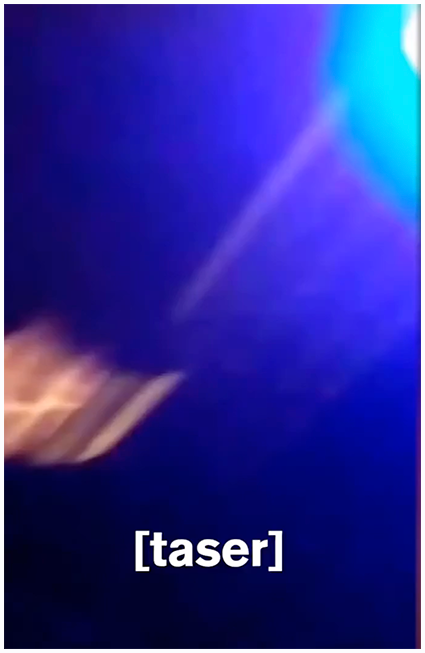
On March 30, 2014, Kianga Mwamba was driving down Harford Road in Baltimore, Maryland, when she suddenly observed numerous officers of the Baltimore Police Department physically beating Cordell Bruce while he was handcuffed on the side of the road. Stopped at a red traffic signal, Mwamba decided to pull out her cellphone and start recording what she was witnessing. This has been a common practice by bystanders, especially in black communities: to record the extreme and often fatal acts of violence by law enforcement. Upon noticing that she was recording them, several police officers swarmed Mwamba’s car. One of them, Erick Jackson, told Mwamba to either leave the scene immediately or pull over to the curb. It was unclear if Jackson’s latter option meant that Mwamba would be “pulled over” on the count that if she did not leave, she would have committed an offense. Mwamba, however, could not pull over or leave. Her car was surrounded by officers. Had she moved forward to leave or to pull over to the curb, she realized, she would have hit one or more of the officers. So she stayed put. Out of nowhere and, as her report against the Baltimore Police notes, “without any provocation, legal justification, or reasonable suspicion to believe [Kianga Mwamba] committed a crime, [Mwamba] was brutally attacked in her vehicle by the [Baltimore police officers].”{1} She was hit multiple times, dragged from her vehicle, and called nearly every expletive known to humankind. She continued to remind them that she had a right to record. She was arrested for “assault of officers” and placed in a holding cell at the Northeastern District police station in Baltimore. All of her personal belongings were confiscated, including the cellphone that had recorded the officers’ beating of Bruce as well as their beating of her.
While in the holding cell, Mwamba told the officers that she had recorded more than just their beating of Bruce, but the entire incident, which included the forms of violence she sustained by them. They were all recorded on her cellphone. While sitting in the holding cell, she informed them that her documentation would “prove that she had not assaulted anyone.”{2} The officers, at some point while she was in the cell, retrieved her cellphone and deleted the video (or so they thought) in an attempt to conceal and destroy the evidence, which, had Mwamba been white, might have been considered a crime. Mwamba did not know that they had retrieved her phone and deleted the video until she was released from the holding cell the next day. She lamented the loss of this evidence—arguably placing a type of faith in legal evidence—because it was all she had of the night; without it, she knew that it would be her word against theirs. Mwamba was devastated.
Mwamba’s teenage daughter reminded her mom that her smartphone made frequent backups of her photos and videos to a “cloud” in order to conserve internal storage on her phone. The video had been deleted from the physical device by the officers, but it had been saved to her Google account. Mwamba gave the video to her attorneys, who then brought it before BPD internal affairs. The charges against Mwamba were dropped. There was no investigation of the officers, so Mwamba posted the video on YouTube. In response the Baltimore police commissioner stated, “The video does not capture enough information to draw definitive conclusions about what transpired before, during, and after the arrest.”{3} She filed a lawsuit against the BPD and would eventually be paid $60,000 by the city of Baltimore.
The case of Kianga Mwamba represents a number of concerns around the question of evidence and agency. Scholars such as Lauren Berlant, Saidiya Hartman, and Ruth Wilson Gilmore offer instructive ways to grapple with the slipperiness of agency and, indeed, the ease with which it can become a fetish. Berlant, for example, offers “lateral agency” to refer to the ways in which the most marginalized construct air pockets for survival, to make do, imagine into existence something else, and enact other practices that we might understand as a choice.{4} But a choice, of course, cannot be disarticulated from the material conditions and structures that shape the functioning of the world. In fact, Hartman has argued consistently that, in light of the violent order of things, we must contend with the “necessary limits or failures” of practices we might understand as agential, as they have historically run the course of masking the operation of power and the expanse and ordinariness of systemic oppression.{5} The risk, too, of fetishizing agency is that, as Gilmore reminds us, we lose sight of the nuanced and contradictory ways that people “in forgotten places also act within the institutional and individualized constraints defined by racialization, gender hierarchy, and nationality.”{6} And while I generally hesitate to use the term agency, I find it helpful here for trying to make sense of how marginalized people make choices when it comes to putting evidence to work, whether toward liberation and/or (both/and) toward receiving financial retribution from the city of Baltimore, in the case of Mwamba. This latter point highlights how evidence has been commodified and can be understood to have an exchange value, and, as my coeditors Sasha Crawford-Holland and Patrick Brian Smith have pointed out, how payouts come with clauses preventing Mwamba and others from engaging in any further legal action. These ways of acting, shaped by one’s material conditions, are not easily contained or defined. They can even be contradictory.
***
“Let them talk and say whatever they want to say. But you know what, watch the video.”
—Kerri Cohen, attorney for Kianga Mwamba
***
Mwamba’s case represents an example of the types of faith we place in visual evidence to prove wrongdoing in the court of law. However, it might also reveal something else. While I locate great potential in black communities to produce forms of evidence, I do not for one second believe this practice is a cure-all. And yet, perhaps it highlights a struggle toward something resembling hope for a future, a better world.{7} What Mwamba’s video and other previous cases like it reveal are the violences visited upon black people when they attempt to declare their humanity, exercise their supposed rights to record, and produce a visual record. The visual has historically been such an important medium for black people to offer counternarratives, counterimages, and other ways of representing the complexities of their experiences to the prevailing, dominant visual culture.
Bringing this history, then, into conversation with scholarship on evidence, and particularly visual evidence, is an attempt to signal how black people have been producing a body of visual evidence. It is what I have referred to as black visual evidence, which, by its nature, challenges formal rules of law that place more value on terms like objectivity and truth. As an analytic and practice that centers black lived experiences as narratives with profound evidentiary weight, black visual evidence intends to induce anxieties and conceptual collisions in encountering terms like truth and objectivity. If, as Fred Moten argues in his book Black and Blur, the “alleged mode of truth” is always shadowed by the untruth that “bears and/or accompanies it in an illicit partnership,” then I define black visual evidence as that which always already shadows and insistently disturbs our normative understanding of veracity, certainty, and even our faith in an alleged Truth.{8}
Indeed, what Mwamba brings into relief are the ways in which black visual evidence does not (and can never) connote complete freedom from violence or from the hands of the law.{9} Mwamba, without question, was attacked and arrested because she made a calculation to record the anti-black violence she witnessed. The videos by black videographers in Los Angeles who recorded the riots in 1992 were used by the LAPD to violently beat and arrest hundreds of individuals who had been identified as participants. In fact, the videos were used as evidence to prosecute them. Mwamba’s brave act also reveals, yet again, how black women are and always have been placing their bodies on the line as witnesses to others’ experiences with anti-black violence. It reveals, too, that they continue to be victims of these same forms of violence.
Think back, for example, to the courtroom testimony of Aiyana Stanley-Jones’s grandmother, Mertilla Jones, who painfully and emotionally described the series of events that led to her granddaughter’s killing by Officer Joseph Weekley of the Detroit Police Department. As she told the story, Jones was instantly overcome with tears. Speaking to the officer directly while on the stand, she wailed, “Why you do it? Why did you come in my house . . . tell me why you came in my house like that.” Jones continued, “You killed her, and you are trying to blame me. You know I never touched you, Mr. Weekley . . . you know I never touched you. You know you wrong. She was only seven years old.” She demanded—insisted—to know why Weekley would kill a sleeping black child. Officer Weekley just sat there, expressionless. As Jones was escorted out of the court, she continued to speak about her experiences since the killing of her granddaughter: “I gets no sleep, the flashbacks . . . I wouldn’t wish them on nobody in the world, not even you.”{10} After Jones’s eyewitness testimony, mainstream media and other commentators were quick to label it an “emotional outburst,” describing it as “chaotic,” “explosive.”{11} Each of these labels clearly positioned her testimony as unreliable and, worse, not credible.
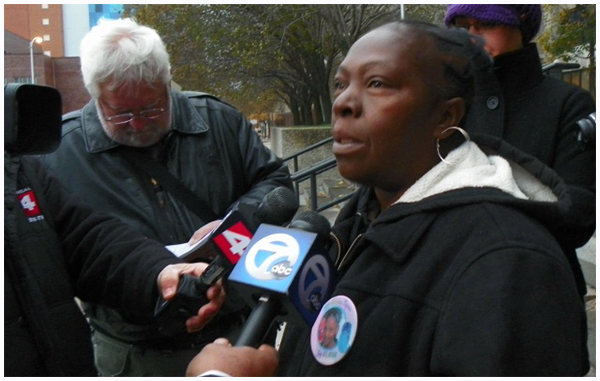 Mertilla Jones, October 2012.
The judge reminded the jury that the case should not be decided based on sympathy or emotion. Judge Cynthia Gray Hathaway, a black woman, told the jury to remain faithful to “the evidence you accept and the laws that apply to that evidence.”{12} On the one hand, Judge Hathaway’s reminder appears to allow members of the jury to form their own interpretation of evidence, while, in another stroke of the hand, it strips the jury of such interpretive power by informing them that whatever evidence they accept will be subjected to the laws on governing evidence.{13} This reminder should be read as the judge suggesting that Mertilla Jones’s testimony is purely emotional, and that within her emotional response, there exist no facts to be accepted as credible and objective. It fails to meet the normative standards of legal evidence. The court reads Jones’s testimony as an attempt to derail the fact finders in an intentional appeal to sympathy, rather than as a form of embodied, affective evidence that is grounded in black people’s everyday experience with anti-black racism and violence. Thus, I want to suggest that, within a black visual evidence framework, Jones’s responses are completely evidentiary. Indeed, they evidence the ways in which hierarchies of objectivity and subjectivity work as powerful discourses to marginalize testimonies by black people who are victims of the brutality of the state.
Furthermore, Jones’s (as well as Mwamba’s) testimony also reveals one of the various ways that black people refuse (“You are trying to blame me,” or “You know I never touched you”) to accept the law’s constant move to simply accept officers’ testimonies as somehow more truthful, which in turn positions black testimony (that is always emotional and less credible) as the means by which their innocence is affirmed. Jones’s visual testimony is not evidentiary enough to be legal proof; it is not evidentiary enough to serve as demonstrative evidence because it is too emotional; it is not evidentiary enough to serve as illustrative evidence of the video footage of the raid that led to Aiyana’s murder because Jones’s eyewitness account is disregarded for the substantive evidence given by Officer Weekley—his being white.{14}
Mertilla Jones’s “You know I never touched you” or “You killed her” disturbs, even if unsuccessfully, the court’s modus operandi to simply believe Officer Weekley’s narrative as a higher truth. Jones’s testimony, like that of so many other black women and maternal figures, is evidence of the ways in which, as Rhaisa Williams argues, black maternal grief “as an affective location and analytic” does not aspire to “make itself legible or communicable.”{15} I argue it is in this type of refusal that black visual evidence is invested. Illegibility itself does not have to always be thought through the framework of failure, as in “failed evidence,” but rather can be taken as evidence of something else. By placing pressure on idealized notions of truth and certainty, I mean to open up a loophole to consider not only alternative types of visual evidence, but also the range of interpretations that can be rendered through a framework such as black visual evidence. This might afford us a glimpse of a future society in which evidence, visual or otherwise, produced by black people is legible and recognized as evidence, but on their own terms.
Mwamba’s case brings into the fold another opportunity to rethink the work and interpretation of evidence. Indeed, it brings a different form of technology into relation with blackness and evidence. The visual documentation that the police thought they had deleted, and that Mwamba thought was completely erased, had in fact migrated to the cloud. In some ways, the video subsisted in the space between life and death: physically dead but technologically alive. Given the thinking around the affordances of new digital technologies in this volume, this added component, technological presence and physical absence, is interesting to sit with. In his insightful A Prehistory of the Cloud, Tung-Hui Hu writes that the “cloud is both an idea and a physical and material object,” and argues that “between this idea of the cloud and the name that we give it—‘cloud’—is a rich site for analysis.”{16} While I will not undertake an analysis of it here, as Hu does such a rich reading of it in his book, I want to point to his engagement with how the cloud has been used by everyday people, activists, and artists to challenge and critique structures of power. For example, he writes, “Whether though activism, art, or simply the narratives written about it, the cloud has offered a platform for unconventional modes of critique and dissent, a medium for loosely organized, decentralized modes of protest.”{17} It should be noted here, however, that Hu does not imagine the cloud as some form of dreamlike astral plane that is immune to violence and incapable of exercising it. He does not fetishize the cloud, nor does he view it as full of disruptive potential. In fact, his cogent analysis of how the cloud has been used as a surveillance platform for targeted killings by military personnel, or how it leads people, through practices of control, to believe that they own their data, reveals how the cloud is an extension of real-world power and politics. The cloud is not neutral. Nonetheless, Hu argues that there is still room for something else in the topography of the cloud. The cloud is constantly changing in real time, and users cannot objectively observe it from within; in this way, I want to suggest, the cloud disrupts a key aspect of a dominant notion of evidence. Hu concedes that the cloud cannot be reasonably understood in any one present moment, and as a result the only strategy is to, well, decipher its prehistory, but more importantly to speculate on its future. For some, the denouement of Hu’s book will leave a lot to be desired because he does not offer a clear ending with concrete solutions. But that’s just it—there are none. Indeed, it is the speculation on the cloud’s future that I find most compelling in Hu’s work. I have called it a hermeneutic of might in much of my scholarship. Black visual evidence asks us to rethink and refract in hopes that some new meaning might appear; might flicker; might compel; might be considered, for the sake of itself, evidentiary.
***

***
Even if speculatively, then, I wonder how the remainder of Mwamba’s video, as an example of black visual evidence, might be said to refuse erasure. I am not wholly sold on this tenuous line of thought, but this volume has raised questions about evidence’s irresolution. I wonder, too, if we are able to imaginatively read this video’s dwelling in the space of the cloud as a type of haunting witness to the forms of anti-black violence that Mwamba and Bruce experienced. What forms of black life are insisted on from the space of the cloud, but also, importantly, insisted on in the space of the cloud’s own propensity for violence? Does black visual evidence have a chance, given how fragile the cloud is and how unstructured its existence seems to be, of remaining fugitive from the juridical desire to determine its evidentiary purpose? How many other photographs or videos of anti-black violence and death exist in the space of the cloud? There, is it possible to suspend the demand of legibility and the extractive request for some conclusive proof? Maybe, maybe not. But what would it mean to imagine toward this horizon?
Title video: Kianga Mwamba cellphone video recording, March 30, 2014.
{1} You can read the entire lawsuit brought against the Baltimore Police Department by Kianga Mwamba. For more stories on this case see Kai Reed, “Woman Claiming Police Attacked Her Tells Story,” WBAL-TV 11, December 11, 2014; Jessica Roy, “Cops Tase Woman Recording Another Person’s Arrest, Call Her a ‘Dumb Bitch,’” New York Magazine Intelligencer, December 11, 2014.
{2} “Kianga Mwamba: Cops Try to Delete Video of Violent, Unwarranted Arrest, but Fortunately It’s Backed Up to the Cloud,” Witness Media Lab, accessed August 28, 2025.
{3} “Cops Try to Delete.”
{4} Lauren Berlant, “Slow Death (Sovereignty, Obesity, Lateral Agency),” Critical Inquiry 33, no. 4 (Summer 2007): 754–80.
{5} Rizvana Bradley, “Regard for One Another: A Conversation Between Rizvana Bradley and Saidiya Hartman,” Los Angeles Review of Books, October 8, 2019.
{6} Ruth Wilson Gilmore, “Forgotten Places and Seeds of Grassroots Planning,” in Engaging Contradictions: Theory, Politics, and Methods of Activist Scholarship, ed. Charles R. Hale (University of California Press, 2008), 36.
{7} See, for example, LaCharles Ward, “Somebody’s—Or Nothing: Visual Evidence, Blackness, and the Limits of Legal Seeing,” History of Photography 45, nos. 3–4 (2021): 363–75; LaCharles Ward, “Black Redaction, Black Evidence: Another Testimony of Black Life,” in A Site of Struggle: American Art against Anti-Black Violence, ed. Janet Dees (Princeton University Press, 2022).
{8} Fred Moten, Black and Blur (Duke University Press, 2017), 44.
{9} Importantly, too, the data centers that propel the function of clouds, where Mwamba’s video was saved, are not without their own violent histories—of the land that they were built on, the people who were forced from it (often people of color), the acts of violence that occurred and continue to occur there. Likewise, as scholars such as Ruha Benjamin and Safiya Noble remind us, technology has a way of hiding preexisting forms of inequality and hierarchy. See, for example, Ruha Benjamin, Race After Technology: Abolitionist Tools for the New Jim Code (Polity, 2019); Safiya Umoja Noble, Algorithms of Oppression: How Search Engines Reinforce Racism (NYU Press, 2018).
{10} “Aiyana Stanley-Jones Grandmother’s Emotional Outburst,” posted October 20, 2014, by Kristen Watts (Daily Unconstitutional), YouTube.
{11} See, for example, Rose Hackman, “‘She Was Only a Baby’: Last Charge Dropped in Police Raid that Killed Sleeping Detroit Child,” Guardian, January 31, 2015; George Hunter, “Aiyana’s Grandmother Grilled in Detroit Cop Case,” Detroit News, September 30, 2014.
{12} “Grandmother’s Emotional Outburst.”
{13} The judge even questioned jurors to determine if Mertilla Jones’s outburst had jeopardized the jurors’ ability to render a fair verdict. They all agreed that they “wouldn’t let the episode affect how they saw the case.” Hunter, “Grandmother Grilled.”
{14} For a deeper discussion of demonstrative and illustrative evidence, see Ward, “Somebody’s – Or Nothing,” where I track the history of these terms in the context of photography and law. See also Jennifer L. Mnookin, “Semi-Legibility and Visual Evidence: An Initial Exploration,” Law, Culture and the Humanities 10, no. 1 (February 2014): 43–65.
{15} Rhaisa Kameela Williams, “Toward a Theorization of Black Maternal Grief as Analytic,” Transforming Anthropology 24, no. 1 (April 2016): 19.
{16} Tung-Hui Hu, A Prehistory of the Cloud (MIT Press, 2016), ix.
{17} Hu, Prehistory of the Cloud, xxii.